
\ STAFF
MDIT staff are connected with a community of local and international experts within their research field. They are actively engaged in government funded and industry partnered research projects that feed into the teaching of MDIT Design Studios, Electives and Major Project supervision.

Dr Areli Avendaño Franco
Areli's research explores how design can facilitate better futures and relationships between humans and the more-than-human world, in the context of climate and social justice, through relationality, pluriversal thinking, storytelling, and critical practice. Her work is grounded in anti-colonial and anti-capitalist principles, treating design as a collective process rooted in hope, imagination, care, and repair.

Dr Chris Henschke
Chris Henschke practices at the intersection of art and experimental science, reworking the technologies and techniques scientists use to express fundamental qualities of nature. He has undertaken various collaborations including the National Gallery of Australia, 2004; the Australian Synchrotron, 2007-2010; the CSIRO nanomaterials laboratory, 2018-2019; and CERN, the European Organisation for Nuclear Research (CERN,) 2014-2018 and the Australian Network for Art & Technology Synapse Fellowship at CERN, 2024.

Dr Courtney Coombs
Courtney's research is grounded in a queer-centric, anti-spectacular and anti-hierarchical practice that reimagines everyday encounters and disrupts dominant narratives about worth and value. Equally enamoured by material and idea, their work moves between making and criticality, often dwelling in the space between the two.

Dr Emma Luke
Emma’s research lies at the intersection of industrial design, wearables, immersive experiences and HCI. Her practice explores the encoding of value through data, materiality, aesthetics, and personalisation, to inform the development of artifacts and experiences that foreground human and ecological health and wellbeing.

Dr Jordan Lacey
Jordan Lacey is a sonic thinker, teacher and creative practitioner, who specialises in urban soundscape design and sonic art practices. His research has been supported across multiple platforms including university, social enterprise, industry and government. He is a senior lecturer in the MDIT program and senior researcher in the Design and Sonic Practice (DSP) research group, and supervises multiple PhD candidates in Australia, Asia and Europe. He has an extensive publication record including authoring three monographs with Bloomsbury Academic, and is the associate editor for the Journal of Sonic Studies (JSS).

Dr Malte Wagenfeld
Malte is a designer, researcher and curator, whose experiential investigations, designs and texts have been internationally exhibited and published. His passion is for building a deep understanding of how cultural, social, technological, and economic developments drive and are driven by design, and how we can leverage this knowledge to reimagine healthy and climate resilient environments for a minus zero carbon future. As well as designing physical ‘things’ his practice investigates how to design the ‘immaterial’, in particular the design of atmospheres; exploring experiential encounters with air, sound, light and smell.

Professor Michael Trudgeon
Michael’s research develops strategies to prototype new technology solutions and new patterns of use that manage the risks of change and innovation. His work responds to issues of climate change which require significant transformation of urban infrastructure, energy and waste systems and living patterns of cities.

Dr Nancy Mauro-Flude
I’m a maker, educator and design anthropologist passionate about the properties of materials, technologies and systems that we often take for granted. My research spans sociotechnical ecologies, media archaeology, networked infrastructures, biodesign and post-carbon practices, including contemporary performance and festival milieus. I am particularly interested in spatial interventions that engage remote, regional and translocal communities.

Dr Ollie Cotsaftis
Ollie’s research operates at the intersection of design and futures, exploring regenerative transitions through material-driven and participatory design. Engaging living systems, critical ecologies and material entanglements, his practice works through engagement, publications, exhibitions and partnerships to explore design’s role in enabling place-based coexistence and mutualism.

Associate Professor Ross McLeod
Ross’s research involves an ongoing study of phenomenological and sensorial approaches to design. This practice examines the cross-modal confluence of the senses, employing the physical and psychological sciences to develop an understanding of the relationship between phenomena, human experience and behavior.
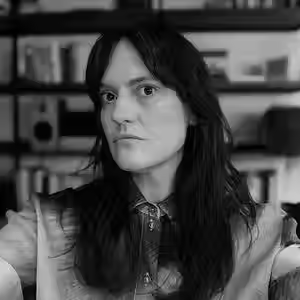
Dr Shell Woulahan
Shell's research focuses on tangible interfaces and ubiquitous computing. Her work explores the societal implications of technology, offering critical insights into the ways in which technological advancements shape and redefine human identity and experience.